

Does your business have an AI strategy?
How about your competitors, do they have an AI strategy? Most industry leading companies not only have an AI strategy, but they’re taking action on this strategy daily to make smarter decisions, move faster, and operate at a scale no traditional human-led heuristic-based business operating model can match. This means, whether you’ve noticed or not, that your business is likely already going head-to-head trying to compete against best-in-class AI.
So, the real question isn’t if your business needs an AI strategy… It’s how soon can you create one if it don’t already have one?
Still, developing an AI strategy can be challenging. The recent rise of artificial intelligence buzz hasn’t made it any easier; unleashing a tidal wave of headlines, LinkedIn hot takes, and industry news; equal parts hype, hope, and hand-wringing. For many business leaders however, the AI “noise” has blurred the signal.
This guide attempts to strip away the confusion and gets to the heart of what matters. Here, you’ll find a clear and practical framework for building a profitable, risk-adjusted AI strategy; one that answers the questions executives should be asking:
- What is AI, really, and what can it do for my business?
- Which opportunities should we seize first?
- How do we prioritize, build, and deploy AI initiatives effectively?
- Most importantly; how do we turn AI into consistent, measurable value while managing risks?
If AI is already reshaping your competitive landscape, the smartest move you can make is to start shaping your own future with it, now.
Step 1: Understanding AI: A Foundational Overview

At its simplest, AI is technology that enables computers and machines to simulate human learning, comprehension, problem solving, decision making, creativity and autonomy. (IBM); learning from data, reasoning through problems, and making decisions. But there’s a lot more to AI than the buzzwords.
Our article, What is AI?, breaks the topic down. It starts by defining AI through multiple lenses, then maps out the landscape, from traditional machine learning and neural networks to cutting-edge reinforcement learning and beyond.
For business leaders, the first step in any AI journey is understanding the tools in the AI toolbox; what they are, how they’re organized, and where they shine. This article serves as your quick, comprehensive primer, giving you the clarity you need to separate hype from reality.
Step 2: Understanding How AI Drives Business Value
AI is a catalyst for transforming how you use data to make decisions.

In our Analytics Maturity Curve article, we explore how organizations can move from simply looking at the past to actively shaping the future. AI powers every step of this journey:
- Descriptive Analytics – Summarizes what happened (e.g., last quarter’s sales reports).
- Diagnostic Analytics – Reveals why it happened (e.g., connecting a sales drop to operational bottlenecks).
- Predictive Analytics – Forecasts what’s likely to happen next (e.g., projecting customer demand).
- Prescriptive Analytics – Recommends what to do about it (e.g., fine-tuning pricing for maximum profit).
The further you progress along this curve, the more your analytics shift from passive reporting to proactive, profit-driving action. The payoff? Competitive advantages like hyper-personalized customer experiences, leaner operations, and faster, smarter decision-making; exactly what it takes to win in today’s AI driven market.
Step 3: Build an AI Strategy Aligned with Business Goals
Understanding AI is just the beginning. Turning AI into business value starts with clarity on your goals.

For most for-profit organizations, the ultimate objective is simple: maximize profit. There are only two levers to pull to achieve this:
- Maximize Revenue
- Minimize Costs
Every AI initiative should connect directly, and obviously, to one of these levers. If a proposed AI project can’t demonstrate a clear path to boosting revenue or cutting costs, its value deserves serious scrutiny.
By grounding your AI strategy in your core business objectives, you ensure every investment drives measurable results—not just technological novelty. Let’s explore each of these in turn:
Maximizing Revenue
For companies selling products or services, AI can be a game-changer for mastering the 4 P’s: Product, Price, Placement, and Promotion.
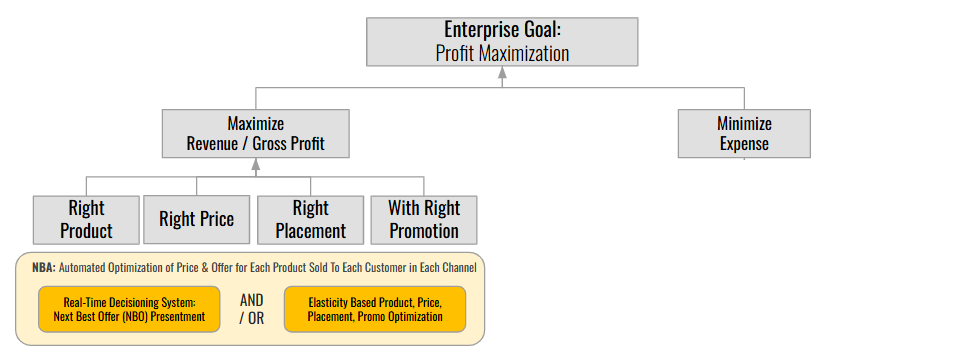
When attempting to maximize decision making in this domain, companies should focus on analyses that drive two key areas; 1) the likelihood that someone will acquire your product or service, or 2) the value of your product or service (e.g. the amount of money that you make with each sale). Let’s discuss each of these:
- Boosting Customer Acquisition Likelihood
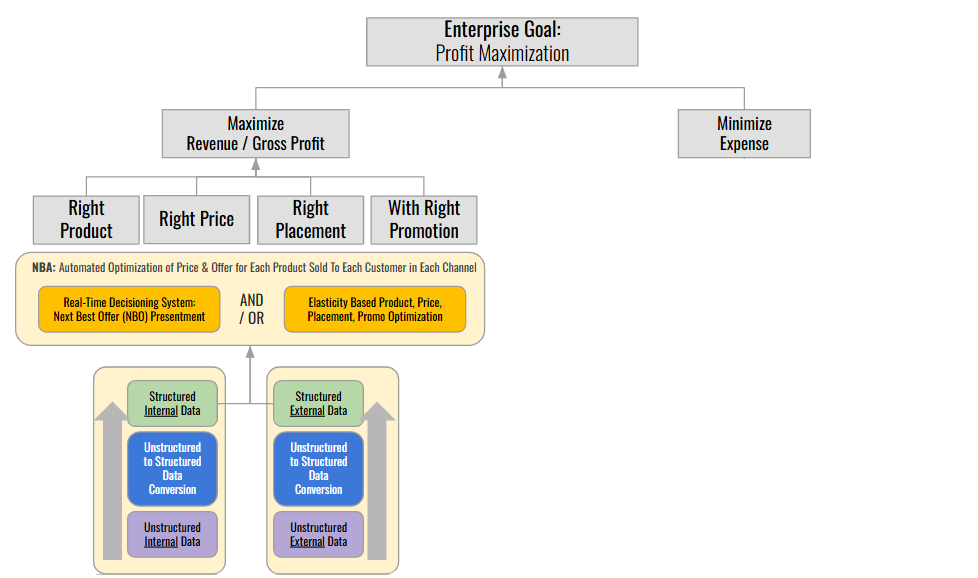
AI can supercharge “Next Best Action” strategies (see Article 1 | Article 2) by analyzing the 4 P’s alongside hundreds/thousands of other variables; from customer behavior patterns to shifting market trends. Insights from these analyses ensure that the optimal product is presented to each customer at the optimal price, with the optimal discounts, via the optimal channel. Example: AI-powered price elasticity models can pinpoint the optimal price for each product, tailored to each offer type, customer segment, and sales channel. The result? Higher conversion rates and, for large organizations, revenue lifts worth tens or even hundreds of millions of dollars. - Increasing Product Value
AI can also be used to uncover insights that enhance and personalize your offerings, delivering better user experiences, justifying premium pricing, and boosting customer retention.
Generative AI: Generative and Agentic AI take this further by structuring unstructured data, like social media sentiment or competitor pricing, and feeding it into NBA frameworks. The result is a “keystone” decision engine that unifies a vast array of data sources, aligns numerous analytical efforts, and enables real-time optimization of customer engagement. Companies that master this often leap far ahead of less analytically mature competitors.
Timing vs. Potential
The upside in the Revenue Maximization space is massive; and often unbounded. Whether refining the 4 P’s for current products or identifying what to build next, the potential lift in revenue and gross profit can be transformative.
- Build time: Initial NBA frameworks can often launch in 2–3 months.
- Full scale: Complex, enterprise-grade optimization frameworks typically take many months/years to perfect.
- Value delivery: Expect initial results only after multiple rounds of in-market testing, which can take many months. The long-term payoff can be game-changing however, often tens or hundreds of millions of dollars for large companies.
Minimizing Costs
AI doesn’t just drive revenue, it can slash costs too (with constraints).
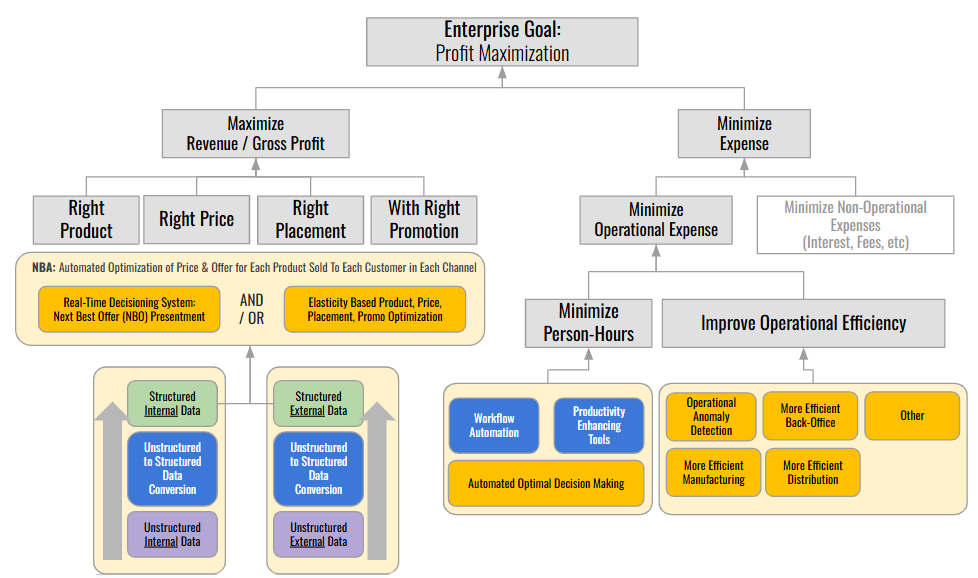
While AI can deliver savings in many areas, the biggest wins in the Expense Minimization space often come from operational efficiencies that transform how a business runs.
1. Reducing Person Hours
AI-powered automation tools, such as workflow optimizers or general-purpose solutions like secure implementations of Copilot or ChatGPT, can streamline repetitive tasks. Agentic AI can fully automate complex processes, like customer support or data entry, freeing employees for higher-value work.
2. Boosting Operational Efficiency
AI can make operations leaner, faster, and more precise. Several areas of application include:
- Anomaly Detection – Catches fraud, stockouts, or abnormal returns early to prevent losses.
- Manufacturing Optimization – Uses IoT data to maximize throughput and minimize waste.
- Distribution Efficiency – Improves routing, customs handling, and supply chain logistics.
- Back-Office Automation – Streamlines invoicing, compliance, and other administrative tasks.
Generative AI: Generative AI tools, including large language models, Agentic AI constructs, and more can be used to deliver significant value in the expense minimization space. From implementations making workflows more intelligent, to Master Data Management (MDM) entity resolution builds, to implementations that enhance safety, generative AI has an important role to play in this space. However, despite the buzz that leaders may have heard in the popular media, GenAI tools are not the solution to every problem. It is important to remember where and when to deploy these tools to ensure consistency, reliability, compliance, and fit for purpose. Our “What is AI?” article mentioned above discusses this in detail.
Timing vs. Potential
The cost-saving benefits of these applications often show up within weeks or months, making them some of the quickest wins in AI. But there’s a ceiling. You can’t save more than you spend, and essential capital and operational expenses will always remain.
That said, AI-driven efficiency gains can still be substantial, measurable, and fast to realize, making them an excellent early focus for organizations starting their AI journey. In summary:
- Build Time: Often rapid, short to medium term solution build times
- Full Scale: Scaling up solutions can often be done quickly.
- Value Delivery: A finite opportunity space. Still, value delivery can be significant.
Step 4: Prioritizing AI Initiatives: A Structured Approach
With countless AI applications possible across both revenue maximizing and expense minimizing domains, prioritization is critical. A disciplined approach ensures resources are allocated to high-impact projects:
- Quantify Business Value: Estimate the financial impact of each AI project. Ask: “How much is spent on this process today?” and “What would a 1% improvement yield?” For example, a 1% reduction in supply chain costs could save millions annually for large firms.
- Create a Value Scatterplot: Plot projects by potential value (y-axis) and implementation timeline (x-axis) to identify quick wins (high value, short-term) and strategic bets (high value, long-term).
- Sequence Initiatives: Determine dependencies between projects. For instance, building a data pipeline may be a prerequisite for predictive analytics. The Next Best Action framework often serves as a “keystone” analytical framework, integrating outputs from other analyses which themselves have to be constructed first.
- Establish Model Governance: Implement robust oversight to ensure analytical outputs are reliable and that they don’t propagate errors across systems. This includes regular model validation and data quality checks. For more, see our article on Model Governance.
Step 5: Deploying AI: Best Practices
Successful AI deployment requires alignment with business goals, scalable infrastructure, and risk management:
- Start Small, Scale Fast: Begin with pilot projects to test ROI, then expand to enterprise-wide solutions.
- Leverage Existing Data: Use structured data where available and employ GenAI to process unstructured sources.
- Ensure Scalability: Build AI systems on secure cloud-based platforms to handle large-scale data and compute needs.
- Mitigate Risks: Address ethical concerns, bias, and regulatory compliance through transparent model design and regular audits.
Step 6: Measuring and Sustaining Value
To derive consistent, risk-adjusted value, track key performance indicators (KPIs) tied to profit maximization or cost reduction. For revenue-focused projects, monitor metrics like conversion rates or average order value. For cost-saving initiatives, track operational metrics like process cycle time or error rates. Regularly review these KPIs to refine AI models and ensure sustained impact.
Conclusion
AI’s potential is massive, but potential alone won’t pay the bills. The value comes from strategic alignment, disciplined execution, and relentless measurement.
When business leaders:
- Understand AI’s true capabilities
- Align every initiative with profit-driven objectives
- Prioritize ruthlessly
- Deploy with strong governance
…they stop treating AI as a buzzword and start using it as a profit engine.
Begin with a clear vision. Build in deliberate, focused steps. Measure everything. Adjust without hesitation. Do this, and AI won’t just support your strategy, it will amplify it.