What is AI? A Practical Introduction for Business Leaders
Speaking with senior business leaders across a range of industries in recent months, we’ve observed both a strong interest in, and significant confusion about, the topic of Artificial Intelligence. In these conversations, one question in particular comes up time and again: “What is AI?”
From the latest breakthroughs in tools like ChatGPT to sweeping claims that Agentic AI will soon render many white-collar jobs obsolete, the media is awash with headlines that portray AI as either a miraculous breakthrough or a looming threat. The result is a dizzying narrative that leaves many business leaders unsure of what to believe, or how to respond.
The leaders we’ve spoken with are eager to ensure their organizations don’t fall behind. While many are driven by a clear sense of FOMO (Fear of Missing Out), they are equally intent on beginning or expanding their AI journey in a thoughtful and strategic way; investing in AI capability builds that stand the best chances of delivering significant ROI, all while carefully managing implementation risks.
Yet despite this desire to act, most admit they’re unsure where to begin, or even what “AI” really means in a business context. This article aims to address that gap by offering a clear and practical overview of AI: what it is, how it works, and where it adds value. Our goal is to help leaders move beyond the hype and move toward informed, high-impact decision-making.
The Hype:
Many AI-related topics, such as Generative AI, Responsible AI, and Artificial General Intelligence, currently sit near the top of the “Peak of Inflated Expectations” in Gartner’s 2024 AI Hype Cycle graph (link). The enthusiasm surrounding AI is understandable: it represents one of the most powerful and transformative technologies of our time.
However, a troubling trend has emerged. A wave of self-styled “AI influencers”, many with little to no background in the field, and others looking to capitalize on the current AI-hype are aggressively promoting multi-million-dollar “GenAI transformations” that claim to be able to solve virtually every challenge a business could face. Companies that buy into this hype often find themselves disappointed: drained of cash and no closer to achieving meaningful business outcomes.
For example, Gartner recently estimated that 40% of “Agentic AI” initiatives will be scrapped by 2027 driven by high costs, lack of business value, and poor risk controls. “Most agentic AI projects right now are early stage experiments or proof of concepts that are mostly driven by hype and are often misapplied. […] This can blind organizations to the real cost and complexity of deploying AI agents at scale, stalling projects from moving into production. They need to cut through the hype to make careful, strategic decisions about where and how they apply this emerging technology.” (Article Link)
“Most agentic AI projects right now are early stage experiments or proof of concepts that are mostly driven by hype and are often misapplied. […] This can blind organizations to the real cost and complexity of deploying AI agents at scale, stalling projects from moving into production. They need to cut through the hype to make careful, strategic decisions about where and how they apply this emerging technology.”
The reality is that a broad ecosystem of AI and machine learning technologies have been around since the 1950s. Far from hype, most are proven, battle-tested tools that underpin trillions of dollars in global economic activity each year. From financial services and supply chain management to retail and wholesale operations, traditional AI solutions quietly and reliably drive value at scale every day.
The key to realizing value from AI lies not in grand promises, but in knowing which tools to deploy, where, and when… including the latest modern advances like large pretrained neural network models and tried and true classical AI/ML tools. This article offers a grounded survey of the current AI landscape to help guide that decision-making.
The key to realizing value from AI lies not in grand promises, but in knowing which tools to deploy, where, and when… including modern advances like large pretrained neural network models and tried and true classical AI/ML tools. This article offers a grounded survey of the current AI landscape to help guide that decision-making.
What Is AI? A Brief Definition
As we begin to explore the breadth, depth, and taxonomy of the overall AI space, perhaps a good place to start is with a high-level definition of “AI”.
AI is technology that enables computers and machines to simulate human learning, comprehension, problem solving, decision making, creativity and autonomy.
While no standard definition for AI exists, this is a relatively clean one, and a solid start to our journey into the AI space. Fundamentally, AI is a domain of tools capable of delivering unique insights and outputs beyond what other tools and techniques are capable of delivering. These tools can mimic and often far exceed the insight generating, problem solving, and other abilities of humans.
With this broad definition now in-place, let’s next dive into a slightly different definition of AI. This definition attempts to define AI in terms of the types of end-insights that AI can deliver, and the incremental levels of value that these insights are able to provide to businesses.
What is AI? Types of Insights and Value Delivery
(click to enlarge)
In this view of AI, we show how AI leverages data to deliver unique insights beyond what other tools and techniques can deliver. AI tools enable businesses to undertake the “Advanced Analytics” portion of the Analytics Maturity Curve shown above (full article here). While this article provides a comprehensive overview of each node on this curve, below is a brief summary of the nodes in the Advanced Analytics section on the right half of this curve.
Diagnostic Analytics:Explaining How Things that Happened Are Related. Diagnostic analytics uncovers the root connections and relationships between variables associated with events, past or present.
Predictive Analytics: Forecasting What Will Happen. AI tools are used to forecast future outcomes based on historical patterns and relationships in data.
Prescriptive Analytics: Determining How To Optimize What HappensNext. This stage focuses on providing actionable recommendations and optimizing decision-making.
Bottom-line, AI enabled Advanced Analytics delivers business insights and value far beyond what raw data, cleaned data, and/or Business Intelligence (BI) dashboards can deliver. While potentially powerful, again, it is important that the right AI tool is used to tackle each business problem in the context of each node on this curve.
Tool Selection :
As business leaders attempt to navigate AI-hype, an analogy speaking to the importance of tool selection can be found in the field of plumbing. If you have a leaky pipe, and you hire a plumber to fix it, if that plumber (i.e. a technical professional) shows up and their first tool choice is to use their recently acquired, extremely complex, and sometimes unreliable pipe repair machine (i.e. the latest GenAI tool), you may begin to have well-founded second thoughts on their services. Could this complex tool be used to fix the problem? Maybe. Would a different and more direct tool be a better choice? Likely so.
If you have a leaky pipe, and you hire a plumber to fix it, if that plumber (i.e. a technical professional) shows up and their first tool choice is to use their recently acquired, extremely complex, and sometimes unreliable pipe repair machine (i.e. the latest GenAI tool), you may begin to have well-founded second thoughts on their services.
Choosing the simplest and most direct AI solution when tackling a business problem is often the best path forward. Still, there are absolutely business problems that GenAI and Agentic AI tools are perfectly adapted to tackle… they are just not the right tool for every problem.
With that in mind, let’s next dive into an overview of the taxonomy of the AI tool space. We’ll cover how these tools are organized, and what kinds of problems each is generally used to solve.
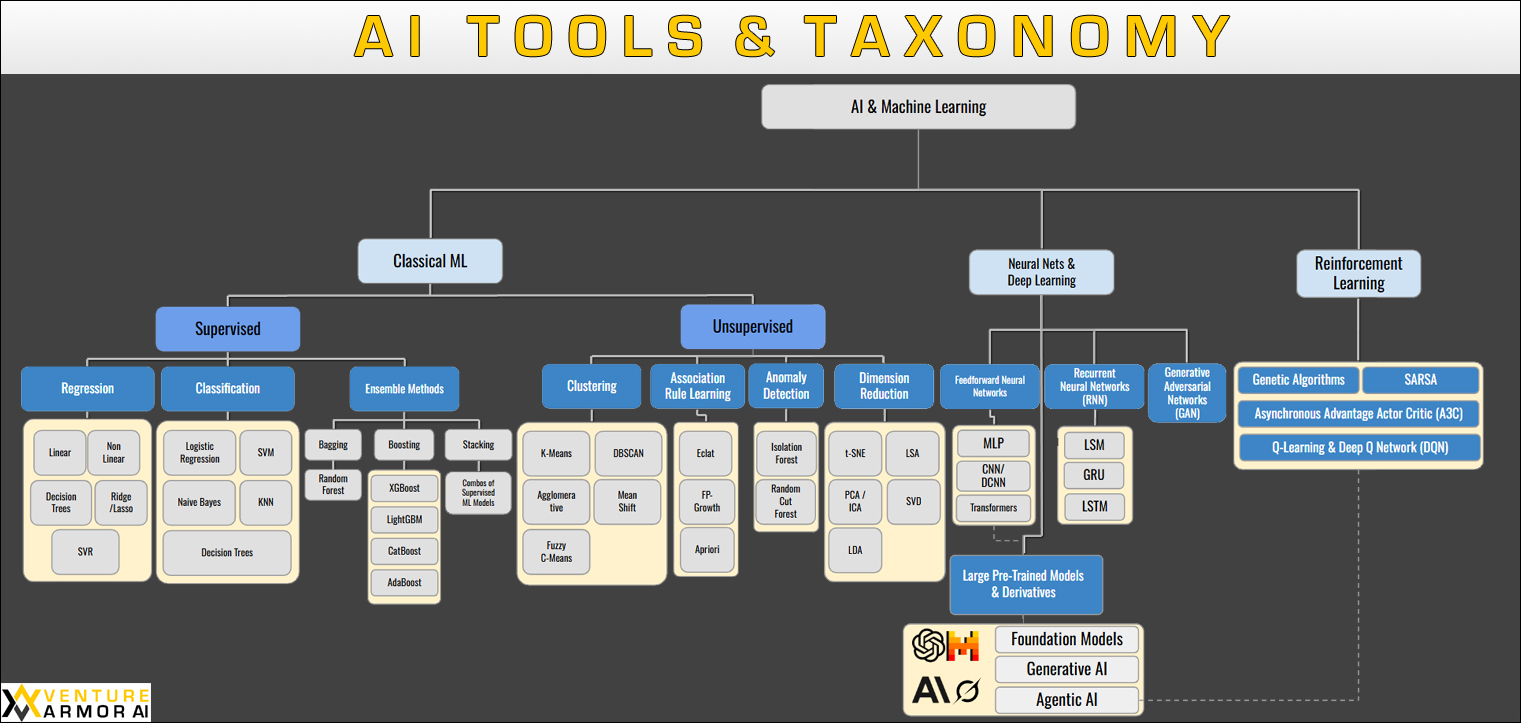
What is AI? AI Tools, Taxonomy, & Uses
(Click to enlarge)
The above diagram provides a high level overview of the taxonomy of the tools in the AI space. Please note that this is not a comprehensive diagram, as hundreds of tools exist in this space. Regardless, most AI tools can be generally categorized into this general structure.
Machine Learning: The Foundation
At the root of our taxonomy sits Machine Learning; the core discipline that enables computers to learn patterns from data without being explicitly programmed for every scenario. Rather than writing specific rules for every possible situation, machine learning algorithms identify patterns in historical data and use these patterns to make predictions or decisions about new, unseen data.
Classical Machine Learning (ML): The Proven Workhorses
(Click to Enlarge)
Classical Machine Learning represents the suite of mature, battle-tested approaches that have driven countless trillions in business value since the first tools in this space were deployed in the 1950’s. These techniques form the backbone of everything from credit scoring systems to marketing optimization systems, and beyond. Modern global business is built on the backbone of classical machine learning assets, with billions of dollars of business decisions being made by Classical ML systems daily.
Supervised Learning
Supervised Learning algorithms learn from labeled training data, essentially learning from examples where we already know the correct answer. This category splits into three primary approaches:
Regression tackles problems where we’re predicting continuous numerical values. Linear regression, for instance, might predict house prices based on square footage, location, and amenities. Financial institutions use polynomial regression models to forecast loan default amounts, while retailers employ these techniques for demand forecasting and inventory optimization.
Classification handles problems where we’re categorizing data into discrete groups. Email spam detection is a classic example, algorithms learn to classify emails as “spam” or “legitimate” based on content patterns. Banks use logistic regression for binary decisions like loan approvals, while support vector machines (SVMs) excel at complex classification tasks like fraud detection, where subtle patterns in transaction data can indicate suspicious activity.
Ensemble Methods combine multiple algorithms to achieve better performance than any individual approach. Random forests and gradient boosting machines are workhorses in data science competitions and production systems alike, used for everything from credit risk assessment to predictive maintenance in manufacturing. Bagging trains multiple models independently on different random subsets of the data and then averages their predictions. Boosting trains models sequentially, with each model learning from the errors of its predecessors. Stacking is where the predictions from two or more models are used as the input for another model, which delivers the final predictions.
Unsupervised Learning
Unsupervised Learning discovers hidden patterns in data without predefined labels, essentially finding structure in unstructured information.
Clustering groups similar data points together. Retail companies use K-means clustering for example, to segment customers based on purchasing behavior, enabling targeted marketing campaigns. Healthcare organizations employ clustering to identify patient populations with similar treatment responses, while telecommunications companies use it to detect network anomalies.
Association Rule Learning identifies relationships between different variables. The classic example is market basket analysis: “customers who buy bread and milk also tend to buy eggs.” E-commerce platforms use these algorithms for product recommendations, while streaming services apply them to suggest content based on viewing patterns.
Anomaly Detection refers to the identification of rare or unusual data points that deviate significantly from the majority of the data. Algorithms like Isolation Forest and Random Cut Forest detect anomalies by modeling how easily a data point can be separated or isolated from the rest of the dataset. These techniques are well-suited for high-dimensional, unlabeled data and are widely used in fraud detection, system monitoring, and predictive maintenance.
Dimension Reduction simplifies complex datasets while preserving essential information. Principal Component Analysis (PCA) is commonly used in finance to reduce the complexity of portfolio risk models, while techniques like t-SNE help visualize high-dimensional data in fields ranging from genomics to social media analysis.
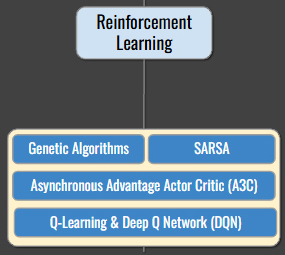
Reinforcement Learning: Learning Through Trial and Error
Reinforcement Learning takes a different approach entirely. Algorithms learn optimal behavior through trial and error, receiving rewards or penalties based on their actions. This mirrors how humans and animals learn through experience.
Gaming provides some of the most visible examples of reinforcement learning in action, from AlphaGo’s mastery of the ancient game of Go to more recent successes in complex video games. However, the real-world business applications are equally impressive: algorithmic trading systems that adapt to changing market conditions, autonomous vehicle navigation systems that learn to handle diverse driving scenarios, and resource allocation systems that optimize everything from data center cooling to supply chain logistics.
The beauty of reinforcement learning lies in its ability to discover strategies that human experts might never consider, often finding counter-intuitive solutions that prove remarkably effective.
While SARSA, A3C, Q-Learning, and DQN have extensive applications in robotics, game playing, and autonomous vehicle navigation, the reinforcement learning tool used most often for general business data science purposes is Genetic Algorithms. Genetic Algorithms are optimization techniques inspired by natural selection, where a population of potential solutions evolves over generations. They are used to solve complex problems, such as optimizing supply chain logistics or designing efficient engineering systems, by iteratively improving solutions through selection, crossover, and mutation.
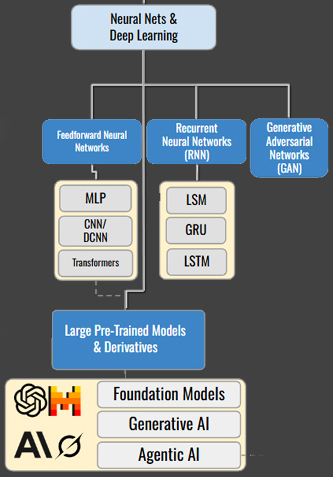
Neural Networks and Deep Learning: The Modern Revolution
Neural Networks and Deep Learning represent the current frontier of AI research and tool development, enabling machines to tackle problems that were previously impossible to solve computationally.
Feedforward Neural Networks Feedforward Neural Networks are the foundational architecture in deep learning, where data flows in one direction, from input to output, without loops. This category includes: MLP (Multilayer Perceptron): Fully connected layers used for basic classification and regression tasks. CNN/DCNN (Convolutional Neural Networks): Specialized for processing grid-like data such as images, using convolutional layers to detect spatial hierarchies and patterns. Transformers: Advanced attention-based models designed to process sequential data in parallel, enabling state-of-the-art performance in language, vision, and multimodal tasks. Transformers are the basis for all modern large models (BERT, GPT, etc.).
Recurrent Neural Networks (RNNs), including specialized variants like LSTMs (Long Short-Term Memory networks), handle sequential data brilliantly. Financial institutions use them for time-series forecasting, predicting everything from stock prices to currency fluctuations. Natural language processing applications, from sentiment analysis to language translation, rely heavily on these architectures.
Generative Adversarial Networks (GANs) represent a fascinating approach where two neural networks compete against each other; one generating fake data, the other trying to detect fakes. Beyond their famous applications in creating realistic images, GANs are used for data augmentation in medical research and generating synthetic datasets for testing systems without compromising privacy.
Large Pre-Trained Models and Derivatives: The Modern Frontier
This taxonomy also includes the cutting-edge developments that are capturing headlines: Large Pre-Trained Models and their derivatives, including Large Pre-Trained Foundation Models, Generative AI, and Agentic AI. These represent the newest branches of the AI family tree, built upon the neural network foundation but capable of remarkable new capabilities.
Large Pre-Trained Foundation Models: Large Pre-Trained Foundation Models are massive neural networks trained on vast, diverse datasets, often containing billions of parameters. These models, such as BERT (Google), GPT-4 (OpenAI), and LLaMA (Facebook), are designed to capture general knowledge and patterns from text, images, or multimodal data. They are pre-trained in an unsupervised or self-supervised manner and can be fine-tuned for specific tasks, making them highly versatile.
Generative AI: Generative AI refers to systems that create new content, such as text, images, audio, or video, by learning patterns from existing data. While often built on Large Pre-Trained Foundation Models, Generative AI focuses specifically on content creation. Techniques include Generative Adversarial Networks (GANs (mentioned above)), Variational Autoencoders (VAEs), and transformer-based models like ChatGPT or Stable Diffusion.
Agentic AI: Agentic AI refers to systems that autonomously perform tasks, make decisions, and interact with environments or users to achieve specific goals. Unlike traditional AI, which reacts to inputs, Agentic AI systems are proactive, leveraging reasoning, planning, and sometimes external tools (e.g., APIs, databases) to execute complex workflows. These systems often incorporate foundation models but emphasize autonomy and goal-directed behavior. More on Agentic AI below.
Quick Reference Summary
Again, choosing the right AI tool to tackle the business challenge you are trying to solve is important. The table below provides a quick-reference summary of the right AI tools for several applications.
Application
Tool
Example
Forecasting: Continuous Values
(Classic ML > Supervised > Regression)
Sales Prediction Analytics
Forecasting: Binary Values
(Classic ML > Supervised > Classification)
Marketing Acquisition Analytics
Optimization
Reinforcement Learning > Genetic Algorithms
Price & Offer Optimization Analytics
Natural Language Processing
Neural Nets > Large Pre-Trained Models
Analyzing Customer Reviews for Sentiment
Dividing Populations Into Natural Sub-Groups
Classical ML > Unsupervised > Clustering
Customer Segmentation
Unstructured Data Analysis
Neural Nets > Large Pre-Trained
Extracting Key Data Elements from PDFs
Please see the following related posts for more information on how AI can be used to solve specific business problems, and the all-important topic of AI governance:
Automated Analytics and “Agentic AI”: Why the buzz?
So far, we have described 1) the types of business insights that AI can deliver, and 2) the taxonomy of the tools in the AI space. While choosing the right AI tool to tackle each business challenge is important, we have not yet discussed whoor what uses these tools? This brings us to the topic of automated analytics and the very hot buzz term: “Agentic AI”.
Manual vs. Automated Analytics:
Traditionally, building, tuning and deploying AI tools was a time consuming process that required expert data scientists to work for weeks on-end to complete. In recent years however, a number of capabilities have been developed that have dramatically sped up the model development process.
AutoML:
When building a model, especially classical machine learning (ML) models, after data scientists have spent time aggregating data, traditionally they would then manually go through the process of sequentially applying a series of different AI models to the data, to see which one provided the best “fit” or predictive “lift” in relation to their target variable. When applying each model, analysts would traditionally have to manually “tune” the parameters (similar to adjusting the controls) for each model in an attempt to maximize the predictive power of each model application. This was a time consuming process, since the number of combinations of parameter/control settings that analysts would have to explore could be quite large for any given model. Tuning these values across all of the models they could use was a process that could take many weeks or months.
For many years now however, various data science platforms (e.g. H2O.ai, Databricks, and others) have deployed solutions categorically labelled as “AutoML” to address this challenge. These solutions automatically and sequentially apply dozens of AI models to a user’s data, automatically and optimally tuning each model’s parameters as it proceeds. These automated model tuning frameworks use either brute force or (the better ones) use genetic algorithms to explore the often highly multidimensional opportunity space, to find the optimal solution. The results from each model tuning run are automatically cataloged, and the system generates a simple report at the end letting the analyst know what model and tuned parameters provide the best fit/lift. These tools have transformed the model development process from something that formerly could take a few weeks/months, to an exercise that often takes less than an hour to complete; all while also generating superior results than could be obtained by attempting to explore the opportunity space by manual means.
Real-Time Decisioning Systems:
While recent developments in the AutoML space have made manual AI model builds faster, easier, and more accurate, an entirely different class of analytical solutions have removed humans from the model construction and deployment loop entirely. Real time decisioning platforms like Pega’s Customer Decision Hub (CDH) are used by companies to not only manage the presentment of text, images, and offers within website and mobile app page real estate, they also automatically optimize the displaying of this content using AI. Pega in particular leverages a Naïve Bayes based content optimization modeling framework to accomplish this task; see above taxonomy (Classical ML) > (Supervised) > (Classification) > (Naïve Bayes). These models, which they call “Adaptive Learning” models, intake data on who is using the website/mobile-app, and automatically optimize the displaying of content.
Depending on the volume of incoming users, and configuration settings within the system, Pega CDH can refit and relaunch various system embedded Adaptive Learning AI models 10 or more times per day… a pace far outstripping what any human could ever do via manual means. While impressive, solutions like Pega CDH are not designed to solve every AI use case. When applied appropriately however, they are absolutely able to automatically deliver massive ongoing value at scale.
Agentic AI:
The “Large Pre-Trained Model and Derivatives” space in our above taxonomy is developing quickly. Many of the AI in this space are now capable of moderate to even advanced reasoning abilities. Models in this space include OpenAI’s ChatGPT, Anthropic’s Claude, X’s Grok, and many others. Many of these models are now connected to a live feed of the internet, and also have access to a variety of coding, data science, and other development tools. While each of these models may have limited innate built-in capabilities, by providing them with real-time access to the web and a variety of other AI and non-AI tools, they are now able to deliver insights far beyond what is available from the training data these models themselves were built on.
This situation is analogous to owning a humanoid robot that itself is incapable of cutting grass because it lacks a built-in grass trimming blade. However, if this robot were able to access a lawn mower, and could competently use it, not only could it mow lawns, but it could potentially mow lawns perfectly 24/7. With Agentic AI (i.e. relating to autonomous AI “Agents”), this is a possibility, and the implications are massive.
As of the time of the writing of this article in late June of 2025 however, while these systems hold tremendous promise, numerous as-of-yet unsolved technical and governance challenges still exist around them that prevent their broad-based production-quality roll out beyond certain limited applications. One of the greatest of these challenges is how to effectively govern their autonomous agentic work, especially when the foundation models upon which they rely are prone to, and are well known to, “hallucinate”; delivering inconsistent behavior.
While we are confident that these challenges will be overcome in time, the Agentic AI systems we have seen to date are not yet able to perform reliably enough to make them suitable for most mission-critical business decisioning/execution applications. Having said that, despite their current inadequacies, they may still be perfectly suited in their present, albeit imperfect forms, for other non-mission-critical supporting applications. We expect these limitations to erode quickly however, and do believe that Agentic AI systems represent the foundation upon which massive reliable future business value will be delivered. Perhaps in another 8 – 12 months these frameworks will be ready for mission critical applications.
Conclusion
In this article, we discussed the dynamic landscape of Artificial Intelligence (AI), addressing the excitement and confusion among business leaders navigating its potential. We clarified AI’s definition, capabilities, and value through a taxonomy of tools, from classical machine learning to cutting-edge Generative and Agentic AI; highlighting their potential applications in delivering diagnostic, predictive, and prescriptive insights.
By distinguishing between the hype of costly and often ill defined “GenAI transformations” and the proven, battle-tested AI solutions that have driven countless billions in value across industries, this article intends to equip business leaders with the insights needed to make informed AI-related investment decisions.
About VentureArmorAI
At VentureArmor AI, we specialize in helping businesses unlock the power of AI to maximize business value delivery; expertly deploying the right AI tool(s) to solve business problems. Our expertise in AI analytics and data-driven solutions enables us to deliver tailored solutions that meet the unique needs of our clients. Contact us to learn more about how we can help your organization achieve its goals through the strategic application of AI. VentureArmor: Delivering ROI with AI.